Introduction
This brief covers four obligations under India’s Digital Personal Data Protection Act: data accuracy, security safeguards, erasure, and Significant data fiduciary audits. For each obligation, iceDQ’s automated data quality testing provides data fiduciaries with continuous, auditable evidence rather than a one-time claim.
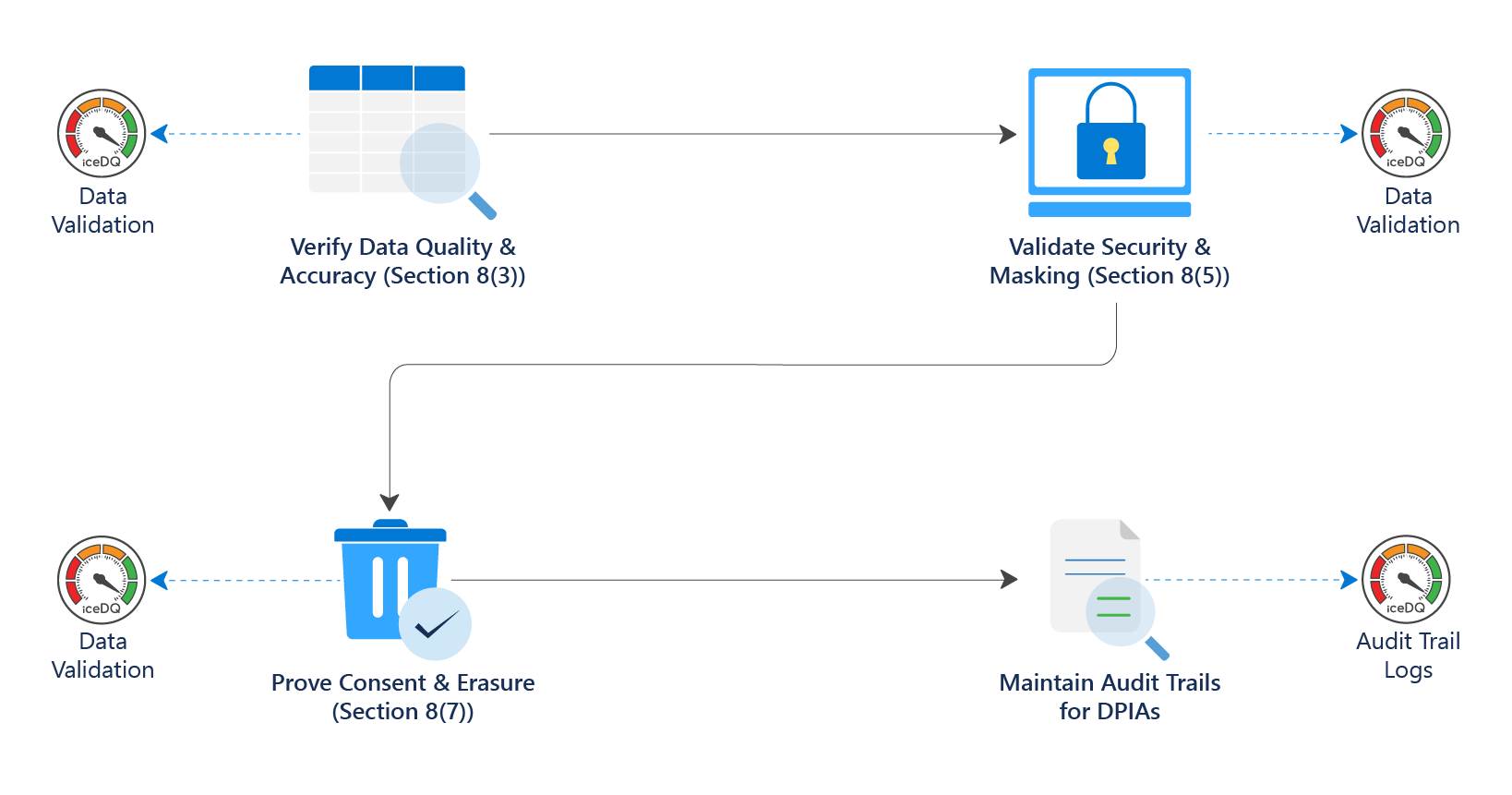
At a Glance
How iceDQ Maps to Your DPDP Obligations
Section 8(3) · Data Quality
Accuracy and Consistency, Automatically Verified
Validation, duplicate, recon, and checksum rules catch incomplete, inconsistent, or mismatched personal data before it is used to make a decision about an individual or shared with another data fiduciary.
Section 8(5) · Security Safeguards
Encryption and Masking, Continuously Verified
Pattern and format checks catch plaintext Aadhaar, PAN, or card values in columns that are supposed to be masked, and confirm the masking is applied on every row, not just some.
Section 8(7) · Erasure & Correction
Proof Requests Actually Took Effect
Scheduled recon and validation rules confirm that a withdrawn consent or erasure request was actually carried out downstream, giving auditable evidence inside the Act's response window.
Significant Data Fiduciary · DPIAs & Audits
A Running Evidence Trail, Not a One-Time Report
Every rule, schedule, and execution result is logged automatically, giving a ready-made record of what personal-data checks exist, when they ran, and what they found, for independent data audits and data protection impact assessments.
Data Accuracy, Completeness & Consistency
Section 8(3) requires a data fiduciary to ensure personal data is complete, accurate, and consistent whenever it's used to make a decision affecting a person, or disclosed to another data fiduciary.
Missing PII before a decision: Completeness check (Validation rule) on mandatory fields, including name, PAN, mobile, email, and DOB, before a KYC, credit, or eligibility decision runs on that record.
Malformed identifiers: Pattern check catching invalid PAN or Aadhaar-format, phone, email, or PIN code values before onboarding data reaches a decisioning system.
Duplicate data principals: Duplicate rule on identity keys (email, phone, PAN) that catches the same person represented inconsistently across two records, which would otherwise skew a decision made "about" them.
Data-sharing accuracy check: Recon rule comparing personal data as it moves from one data fiduciary or system to another (CRM → partner API, core system → analytics platform), proving the disclosed data matches, row for row.
Decisioning-feed drift: Recon between the system of record and whatever feeds a decision engine (income data into loan underwriting, usage data into a risk score), catching drift before it affects the outcome.
Reference-data accuracy: Validation against lookup or reference tables (state codes, ID-type codes, product eligibility tables) so segmentation or eligibility decisions aren't built on bad categorical data.
Post-migration integrity: Checksum or recon rule run right after an ETL or migration job moves personal data, confirming nothing was dropped, duplicated, or corrupted en route to a downstream decisioning or sharing system.
DOB and age validation: Date-format and range check on date-of-birth fields, since these commonly drive age-gated or eligibility decisions.
Internal consistency: Conditional-compare check (for example, "if marital status = married, spouse name shouldn't be null") that catches self-contradictory personal data before it's used.
Large customer-table checks: Pushdown rule for accuracy and completeness testing directly at the source when the table is too large to pull into the engine economically.
Reasonable Security Safeguards
Section 8(5) requires reasonable security safeguards to prevent a personal data breach. iceDQ doesn't encrypt or mask data itself, but it can verify that the encryption and masking you already have in place is actually working.
Plaintext leak detection: Pattern check (regex) scanning a column that's supposed to be masked or encrypted for anything that still matches a raw Aadhaar (12-digit), PAN, or card-number shape, catching rows where masking silently didn't apply.
Masking-format verification: Pattern or length check confirming a masked column actually looks masked (for example, an XXXX-XXXX-1234 shape, or a fixed ciphertext length) on every row, not just some, catching partial or inconsistent masking after a schema change or a new data load path.
Erasure & Correction
Section 8(7) is the erasure duty, triggered when a data principal withdraws consent, or as soon as it's reasonable to assume the specified purpose is no longer served. Correction is technically a data principal right under Section 12, but since a data fiduciary must act on both within the same response window, this brief treats them together. iceDQ doesn't execute the deletion or correction itself; it verifies that the deletion or correction actually happened.
Erasure verification post-request: Validation or recon rule run after a withdrawal or erasure request is processed, confirming the data principal's record is actually gone from the source system, not just flagged or soft-deleted.
Downstream propagation check: Recon rule comparing an erasure-request log against every downstream system the data was disclosed to (CRM → warehouse → partner feed), confirming the deletion cascaded everywhere, not just at the system of record.
Correction propagation check: Recon rule confirming a correction made upstream (corrected address, corrected DOB) actually reached dependent systems, catching cases where a record was fixed in the CRM but a stale copy is still live in the warehouse or a partner extract.
Residual or orphan copy detection: Validation or duplicate rule scanning staging tables, file exports, and derived or reporting tables for leftover copies of an erased record, since the primary table being clean doesn't mean the ETL staging area or a CSV extract is.
Purpose-cessation staleness check: Date or custom check flagging records tied to a lapsed purpose (account closed N days ago, lead disqualified, trial expired) that haven't been erased yet, operationalizing "as soon as it's reasonable to assume the purpose is no longer served" as a measurable rule rather than a judgment call.
Consent-withdrawal backlog reconciliation: Checksum or recon rule comparing the count of open withdrawal or erasure requests against the count of matching records still active in source, giving a fast, repeatable proof point that processing is keeping pace with intake.
Scheduled, recurring verification: Put the above on a daily or weekly schedule so there's a running, timestamped record of compliance rather than a one-time check, providing evidence for the response-time requirement.
Exception report as the audit trail: Every failure, such as "record X still present 3 days after erasure request," lands in a timestamped exception report, the artifact to hand a data protection Board inquiry, an internal audit, or a Section 8(10) grievance-redressal request as proof of compliance or a specific, dated gap.
Significant Data Fiduciary
DPIAs & Audits
Rule 13 of the DPDP Rules, 2025 requires a notified significant data fiduciary to run a data protection impact assessment once every 12 months, engage an independent data auditor to verify the Act's safeguards are actually implemented, and perform algorithmic due diligence, verifying that technical measures, including algorithmic software, don't pose a risk to data principals. The auditor must then report significant observations to the data protection board. iceDQ doesn't perform the DPIA or the independent audit itself, and it doesn't audit an algorithm's logic; it is the evidence layer underneath both.
DPIA risk-assessment input: iceDQ's rule and check inventory across connected systems is a documented record of what personal data is tested, where, and how, feeding the risk-assessment and mitigation-measures section of the annual DPIA instead of drafting it from scratch each cycle.
Independent auditor's evidence pack: Execution history and exception reports across every connected system give the independent data auditor a real record of whether safeguards were actually operating over the audit window, not just documented as policy.
Continuous coverage versus a point-in-time snapshot: Because checks run on a schedule rather than once, the auditor gets evidence spanning the full 12 months being assessed, not a single day's spot-check.
Change detection between DPIA cycles: Recon or
Validation rules re-run after a schema change, a new integration, or a new downstream data flow surface new or changed processing between annual DPIAs, instead of it going unnoticed for a year.
Data-quality evidence for algorithmic due diligence: iceDQ can't audit a model's logic, but it can validate the completeness, accuracy, and consistency of the data feeding an algorithmic system (a credit-risk model, an eligibility scorer), documented evidence that the inputs and outputs aren't silently corrupt or inconsistent.
Coverage-gap mapping: Workflows and rule definitions organized by system or data domain answer the first question any auditor or DPIA reviewer asks, namely which systems handling personal data have controls and which don't.
Timestamped observations for Board reporting: Since the auditor must furnish significant observations from the DPIA and audit to the Data Protection Board, iceDQ's timestamped exception reports and run history give specific, dated findings to cite rather than reconstructing them at audit time.
Good to know
Across every section in this brief, iceDQ is a verification layer, not the system that encrypts, masks, deletes, corrects data, or performs a DPIA or audit itself; those stay with your source systems, your DPO, and your independent auditor. Exception reports also contain the actual failing records, so a rule that flags an unmasked Aadhaar number or an un-erased record puts that data into the report, and securing that storage remains your responsibility. iceDQ is ISO 27001 and SOC 2 Type II certified; DPDP-specific compliance mapping is available on request.