



Data errors in pipelines, reports, and APIs silently compound into costly decisions. iceDQ gives data and QA teams a single platform to automate data validation, reconciliation, regression, and test management across every layer of their data stack, with 200+ connectors spanning databases, cloud warehouses, flat files, APIs, and BI tools.
ETL Data validation Testing
Automate data validation across every stage of your ETL pipeline ensuring data meets quality standards before it reaches production.
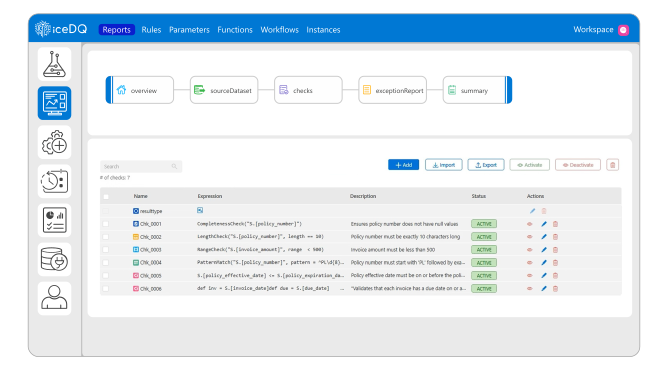
- Completeness Testing:Detect unexpected null, blank, or missing values in critical fields before data reaches downstream consumers.
- Format and Pattern Validation: Enforce data type, format, and pattern rules across source and target to catch structural mismatches early.
- Range and Threshold Checks: Validate numeric and date values fall within acceptable business-defined boundaries.
- Business Rule Validation: Enforce domain-specific rules such as value ranges, mandatory fields, and data classifications to ensure data integrity
- Referential Integrity Testing: Validate that foreign key values in a dataset exist in the referenced master or lookup table, ensuring no orphan records.
ETL Data validation Testing
Automate data validation across every stage of your ETL pipeline ensuring data meets quality standards before it reaches production.
- Completeness Testing:Detect unexpected null, blank, or missing values in critical fields before data reaches downstream consumers.
- Format and Pattern Validation: Enforce data type, format, and pattern rules across source and target to catch structural mismatches early.
- Range and Threshold Checks: Validate numeric and date values fall within acceptable business-defined boundaries.
- Business Rule Validation: Enforce domain-specific rules such as value ranges, mandatory fields, and data classifications to ensure data integrity
- Referential Integrity Testing: Validate that foreign key values in a dataset exist in the referenced master or lookup table, ensuring no orphan records.
ETL Data Reconciliation Testing
Reconcile source and target datasets at full volume across 200 + connectors ensuring no data loss or corruption across your ETL pipeline.
- Source to Target Reconciliation: Compare data across heterogeneous platforms and systems verifying record counts, column values, and schema alignment between source and target.
- Transformation Testing: Verify row-level transformations such as calculations, aggregations, and conversions between source and target.
- Checksum Reconciliation: Reconcile aggregate sums, counts, averages, min, and max values across platforms and systems.
- Medallion Layer Reconciliation: Validate data consistency across bronze, silver, and gold layers ensuring accuracy and completeness at every transformation stage.
Regression Testing
Rerun saved workflows of data testing rules after every pipeline change, release, or data load to instantly identify what is passing and failing.
- Workflow Based Test Suites: Group data testing rules of your choice into workflows aligned to a pipeline, domain, or release cycle and execute them together in a single run.
- Orchestrate and Schedule: Orchestrate rules in a sequence across source, target, and medallion layers and schedule automated executions aligned to your pipeline or reporting cycle.
- Regression on Pipeline Changes: Rerun existing workflows after pipeline code or transformation logic changes to detect unintended impact before issues reach downstream consumers.
CICD Integration
Embed data testing as a native stage in your DataOps pipeline, ensuring data quality gates are enforced automatically before every deployment.
- DataOps Enablement: Trigger iceDQ workflows directly from any CI/CD platform including Jenkins, GitHub Actions, Azure DevOps, and more via out of the box REST API.
- Exit Code Based Pipeline Control: iceDQ returns pass or fail exit codes after every workflow execution, automatically stopping pipeline progression when data quality thresholds are not met.
- Environment Promotion Testing:Run data testing workflows across dev, QA, and production environments to validate data consistency at every stage before promoting a release.
Test Management Integration
Connect data testing outcomes to the tools your QA and engineering teams already use, eliminating the gap between data testing and application testing workflows
- Automated Defect Tracking: Integrate iceDQ with any test management platform including Jira, Azure DevOps, and more to automatically create, update, and close defect tickets based on rule results.
- Consolidated Test Reporting: Get a unified view of data testing results alongside application defects, giving QA teams a single pane of glass for all testing outcomes.
- Audit Ready Test Evidence: Maintain a complete history of every test run, rule result, and workflow execution to support audit, compliance, and sign off requirements.
PRODUCT HIGHLIGHTS
 |
AI Agent: |  |
Automatically generate data testing rules from ETL code, mapping documents, or plain English descriptions |
 |
Low code-no code: |  |
Build data testing rules using pre-built checks for completeness, range, length, datatype, pattern, conditional logic, and more without writing it manually |
 |
Performance and scalability: |  |
Reconcile millions of records in minutes, not hours, with iceDQ's in-memory rules engine and no restriction on the number of records or columns that can be processed. |
 |
200+ connectors: | |
iceDQ natively supports reconciliation across files, API(s), databases, applications, BI reports, SAP, CRM, cloud vs on-premises, Kafka and many more |
|
API First: | |
Invoke any iceDQ rule, workflow, or schedule programmatically via out of the box REST API |
|
Exception reporting: | |
Every reconciliation run produces an exception report with mismatches at record and column level showing source value and target value for each discrepancy |
|
Files & Semi structured data: | |
Test structured files such as CSV and Excel as well as semi structured formats including JSON, XML, and Parquet directly |
|
Notifications: | |
Send automated alerts and notifications via email, Slack, Microsoft Teams, when rules or workflow fail or succeeds |
|
Reporting & Dashboards: | |
Monitor data testing health across pipelines, domains, and environments through real time dashboards showing pass, fail, and trend metrics for every workflow execution. |
|
UDF & Parameterization: | |
Extend iceDQ's testing capabilities with user defined functions and reusable parameters to handle complex business logic and dynamic test configurations at scale. |
|
Advanced scripting: | |
Write custom test logic in Groovy or Java for complex scenarios that go beyond pre-built rule types. |
| ETL/Data Pipeline Testing |
|
Data Migration Testing |
|
| BI Report & Dashboard Testing |
|
File Testing |
|
| Big Data/ Lakehouse Testing |
|
API Data Testing |
|
Automate your iceDQ & Data Testing with iceDQ today
Side CTA - Request a demo
FAQs: Power BI testing with iceDQ
What types of data sources does iceDQ support for data testing?
iceDQ supports 200+ connectors spanning databases, cloud warehouses, flat files, APIs, BI platforms, applications, SAP, CRM, Kafka, and more across cloud and on-premises environments.
Is iceDQ compatible with my existing ETL platform?
Yes. iceDQ is ETL tool agnostic and works with any ETL platform. It validates the data output produced by the ETL regardless of whether the pipeline is built on Informatica, Azure Data Factory, Talend, dbt, SSIS, or any other platform.
Can iceDQ test data across platforms?
Yes. iceDQ connects to on-premises systems like Oracle, SAP, and SQL Server as well as cloud platforms like Snowflake, Databricks, and Azure Synapse, enabling data testing across heterogeneous platforms within the same test execution.
Does iceDQ support full volume testing without sampling?
Yes. iceDQ runs full volume testing across every row and column without sampling, ensuring no defect goes undetected regardless of data volume.
Can iceDQ test structured and semi structured files?
Yes. iceDQ tests structured files including CSV and Excel as well as semi structured formats including JSON, XML, and Parquet directly without pre-processing or transformation.
Does iceDQ support API data testing?
Yes. iceDQ connects to REST APIs via out of the box connectors and validates API responses for completeness, business rule compliance, and reconciliation against source databases.
Can iceDQ validate BI report data against source systems?
Yes. iceDQ connects natively to Power BI via XMLA and Report connectors, Qlik Sense, Tableau, and other BI platforms to validate report data directly against underlying source systems at full volume.
How does iceDQ handle complex transformation testing?
iceDQ supports SQL expressions, Groovy scripting, and User Defined Functions to handle nearly 100% of testing scenarios. The AI Agent further accelerates rule creation from mapping documents or natural language prompts.
Can iceDQ send alerts and notifications when a test fails?
Yes. iceDQ sends automated alerts via Email, Slack and Microsoft Teams when a rule or workflow fails, enabling teams to act before issues reach downstream consumers.
Does iceDQ support AI based rule generation?
Yes. iceDQ’s AI Agent generates data testing rules from natural language prompts, mapping documents, or schema auto-discovery, enabling teams to build test coverage across hundreds of tables without manual authoring.
Does iceDQ support regression testing?
Yes. iceDQ workflows can be rerun after every pipeline change, data load, or release to detect unintended impact on data quality, with scheduled execution and instant pass or fail visibility across every rule in the workflow.
Can iceDQ integrate with test management platforms like Jira and ServiceNow?
Yes. iceDQ integrates with Jira, ServiceNow, and other test management platforms to automatically create, update, and close defect tickets based on rule results,